
The Calf Muscle Pump: Why Your “Second Heart” Matters
Updated: Oct 20
When we think about cardiovascular health, our attention naturally turns to the heart. We often focus on heart rate, blood pressure and aerobic fitness, but another important part of circulation is found much further down the body — in our calf muscles.
Often referred to as the “second heart,” the calf muscles play an important role in helping blood return from the lower legs to the heart. Understanding how this mechanism works highlights why regular movement and maintaining muscle strength are important for long-term health.

What Is the Calf Muscle Pump?
Every time you walk, climb stairs or flex your ankles, your calf muscles contract and compress the veins in your lower legs. This helps push blood upwards against gravity, back towards the heart. One-way valves in the veins help prevent blood from flowing backwards.
Think of it as a natural pumping mechanism that works alongside your heart to support circulation. When we move regularly, this pump helps reduce blood pooling in the lower legs and supports the return of blood to the heart.
What Does Research Tell Us About the “Second Heart”?
Research highlights the importance of calf muscle function for circulation and provides some interesting insights into its connection with overall health.
Calf function and longevity: A study published in Vascular Medicine in 2020 found that people with impaired calf muscle pump function had higher 10-year mortality rates than those with normal function (17.5% compared with 5.9%). These findings highlight a potential link between calf function and overall health, although they do not prove that impaired calf function directly causes earlier death.
Supporting blood sugar regulation: The soleus is a deep calf muscle that plays an important role in sustained, low-intensity activity. Research suggests that repeatedly contracting this muscle through a specific seated exercise, known as a soleus push-up, may help improve blood glucose regulation after eating. Early findings are promising, but more research is needed to establish its long-term benefits, particularly for people with diabetes.
Maintaining healthy circulation as we age: Walking, stair climbing and calf-strengthening exercises help maintain muscle function and support venous return. Regular movement can also help reduce prolonged blood pooling and associated leg discomfort or swelling.
A Holistic Perspective: Circulation and Lymphatic Flow
From a naturopathic perspective, supporting circulation also means considering how movement contributes to fluid balance throughout the body.
While the heart drives blood through the arterial system, the return of blood through the veins relies partly on skeletal muscle contractions and one-way valves. The lymphatic system also depends on muscle movement, breathing and other mechanisms to help transport lymph fluid back towards the bloodstream.
When we spend long periods sitting or standing still, fluid can accumulate in the lower legs, sometimes contributing to a feeling of heaviness or swelling. Regular movement helps support both venous return and lymphatic flow.
Simple Ways to Keep Your “Second Heart” Active
You don't need an elaborate routine to give your calf muscles more attention. Small, consistent habits can make a difference.
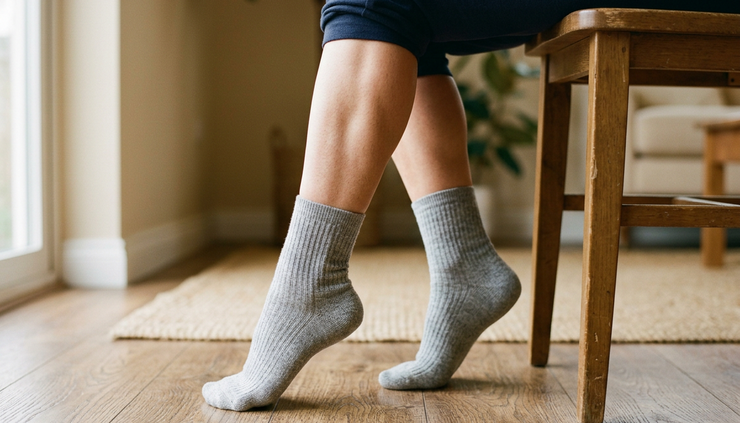
Try seated heel raises: While sitting with your feet flat on the floor, lift your heels while keeping your toes down, then lower them slowly. Repeat comfortably for a minute or two, building up as tolerated.
Move regularly throughout the day: Take short walking breaks, especially if your work involves prolonged sitting. Ankle circles and gentle ankle flexes can also help interrupt long periods of inactivity.
Build strength and mobility: Walking, hiking, stair climbing and resistance training help maintain lower-leg strength, balance and mobility as you age.
Support overall vascular health: Enjoy a varied, wholefood diet rich in vegetables, fruit, legumes, nuts and seeds, alongside adequate hydration and regular physical activity.
Hydration, comfortable footwear and avoiding long periods of stillness can also support leg comfort. Compression stockings may help some people, but they should be fitted and used with professional guidance, especially when medical conditions are present.
Summary
The heart may be the main pump, but the calves play a real supporting role. Each step, ankle flex and heel raise helps move blood upwards from the legs, supporting circulation and reducing the effects of stillness.
The goal is not to obsess over calf exercises. It is to respect how much the body relies on regular movement. Walk often, break up sitting, keep the lower legs strong and use simple movements throughout the day.
This article is for general information only and is not a substitute for medical advice. If leg swelling, pain or circulation symptoms are new, severe or one-sided, seek professional care.
Reference:
Halkar, M., Medina Inojosa, J., Liedl, D., et al. (2020). Calf muscle pump function as a predictor of all-cause mortality. Vascular Medicine, 25(6), 519–526. https://doi.org/10.1177/1358863X20953212
Hamilton, M. T., Hamilton, D. G., & Zderic, T. W. (2022). A potent physiological method to magnify and sustain soleus oxidative metabolism improves glucose and lipid regulation. iScience, 25(9), 104869. https://doi.org/10.1016/j.isci.2022.104869
McBane, R. D., Liedl, D., Wysokinski, W., et al. (2024). Calf rEF: Impact of calf muscle pump dysfunction with reduced ejection fraction on all-cause mortality. Mayo Clinic Proceedings, 99(6), 902–912. https://doi.org/10.1016/j.mayocp.2023.08.013
Orr, L., Klement, K. A., McCrossin, L., et al. (2017). A systematic review and meta-analysis of exercise intervention for the treatment of calf muscle pump impairment in individuals with chronic venous insufficiency. Ostomy Wound Management, 63(8), 30–43. https://pubmed.ncbi.nlm.nih.gov/28873064/
Scallan, J. P., Hill, M. A., & Davis, M. J. (2016). Lymphatic pumping: Mechanics, mechanisms and malfunction. The Journal of Physiology, 594(20), 5749–5768. https://doi.org/10.1113/JP272088
Vaishya, R., Vaish, A., Gopinathan, P., & Misra, A. (2026). Non-weight-bearing lower-limb simple resistance activities, soleus push-ups, and muscle stretching: Impact on glycemic control and metabolic-circulatory outcomes. Diabetes & Metabolic Syndrome: Clinical Research & Reviews, 20(2), 103375. https://doi.org/10.1016/j.dsx.2026.103375
Williams, K. J., Ayekoloye, O., Moore, H. M., & Davies, A. H. (2014). The calf muscle pump revisited. Journal of Vascular Surgery: Venous and Lymphatic Disorders, 2(3), 329–334. https://doi.org/10.1016/j.jvsv.2013.10.053


Comments