
Transform Your Plate: Simple Strategies for Energy and Health

What does your plate usually look like at mealtime?
As a Naturopath, this is one of the first questions I ask during client consultations. Often, once we dive into the 'why' behind meal plating, my clients realize they tend to load up on carbs and protein but fall completely short on fiber.
This common pattern can quietly drain your energy, slow down your digestion, and even disrupt your sleep (Binks et al., 2020).
The good news? By making a simple swap—adding more colorful vegetables and slightly reducing your carb portions—you can experience a noticeable improvement in how you feel throughout the day.
In this post, we will explore a practical and balanced approach to structuring your plate. This method is based on clinical nutrition research and is proven to support blood sugar control, natural appetite regulation, and gut health.
You will learn how to create meals that deliver essential nutrients without overwhelming your digestive system, helping you avoid energy crashes and blood sugar spikes.
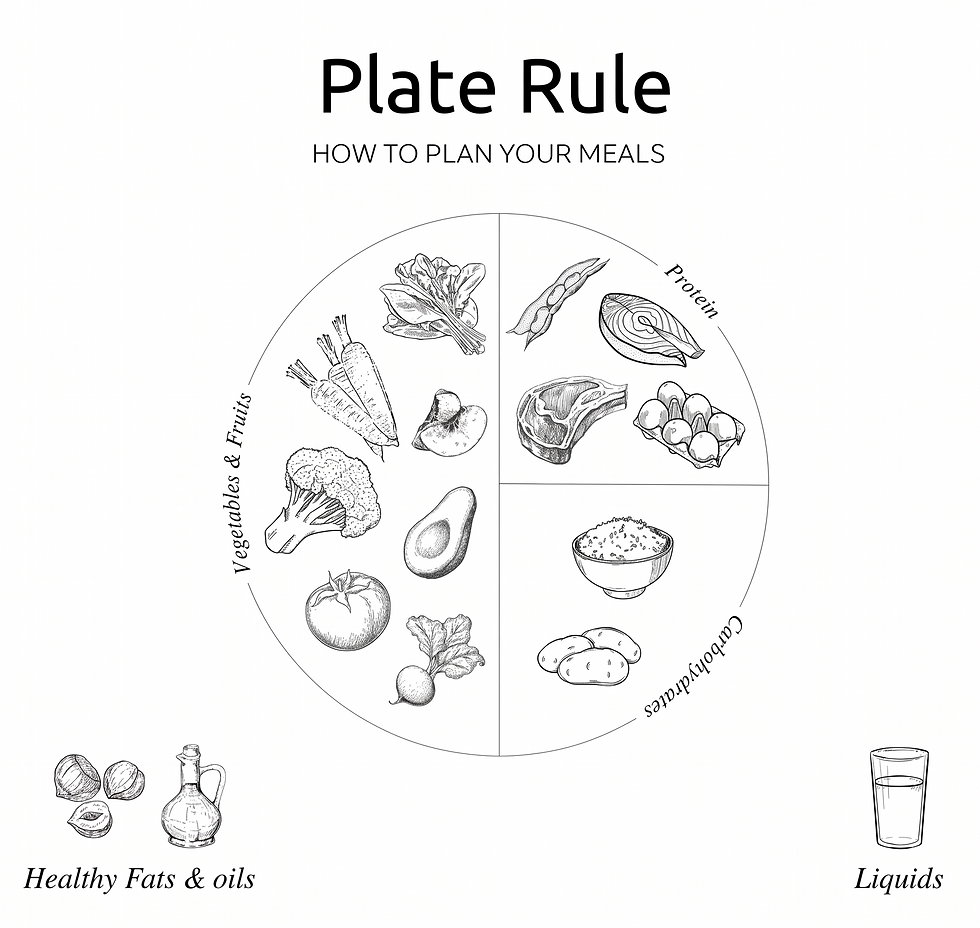
How to Structure Your Plate for Better Health
A simple rule I often share during consultations is to divide your plate into three parts:
1/2 of your plate: Fiber-rich vegetables
1/4 of your plate: Lean protein
1/4 of your plate: Complex carbohydrates
Add healthy fats like extra virgin olive oil, feta cheese, avocado, nuts, or seeds to complete your meal. This balance provides a variety of nutrients while keeping your digestive system comfortable.
Why This Works
This approach helps you avoid the common pitfall of eating too many carbs or too much protein without enough fiber. Here is how each component supports your body:
Vegetables provide fiber, vitamins, minerals, and antioxidants with very few calories.
Lean protein supports muscle repair and keeps you feeling full longer.
Complex carbohydrates offer sustained energy without rapid blood sugar spikes.
Healthy fats improve nutrient absorption and add flavor.
Here is a deeper look at the three core mechanisms behind this method:
1. Blood Sugar Stabilization
Eating carbohydrates alone causes a quick rise in blood sugar, followed by a sharp drop. This drop often leads to that familiar "low energy" feeling.
When you fill half your plate with fiber-rich vegetables and include protein, your body processes carbohydrates much more slowly (Anderson et al., 2009). This slows glucose absorption, preventing those exhausting spikes and crashes.
Simple Swap: Swapping a large serving of white rice for a smaller portion combined with broccoli and grilled chicken can keep your blood sugar steady for hours.
2. Satiety and Appetite Regulation (Natural GLP-1)
Protein, fiber, and healthy fats are the most filling nutrients. When you eat them, your body releases natural satiety hormones—including GLP-1—which communicate directly with your brain to control hunger and reduce overeating (Halton & Hu, 2004).
When your plate is balanced with these components, you avoid overwhelming your system with too much food at once, and you are far less likely to snack on unhealthy options later.
Simple Swap: A meal with roasted vegetables, complex carbs (such as quinoa, brown rice, or lentils), and salmon will keep you full much longer than a plate heavy on pasta and meat alone.
Craving a special pasta night? Here is a tip for you: You can absolutely still enjoy it! Make meatball pasta instead of using a standard mince or have a grilled chicken breast with your pasta to ensure you are getting an adequate amount of protein. Then, scale back your pasta serving to 1/4 of the plate, and load the remaining 1/2 of your plate with leafy greens, cucumber, cherry tomatoes, and half an avocado.
3. Micronutrient Density and Gut Health
Vegetables are packed with micronutrients that support overall health. The different colors in vegetables represent various phytonutrients and antioxidants, each offering unique benefits.
The fiber in vegetables also acts as prebiotics, directly feeding the beneficial bacteria in your gut (Holscher, 2017). A healthy gut microbiome improves digestion, immune function, and even mood.
Try including a variety of colors on your plate to ensure a broad spectrum of nutrients, such as:
Red bell peppers
Orange carrots
Green spinach
Purple cabbage
Yellow squash
Practical Tips to Transform Your Plate Today
Start with vegetables: Fill half your plate with a colorful mix of raw, steamed, or roasted veggies.
Choose lean proteins: Opt for chicken breast, turkey, fish, tofu, or legumes.
Pick complex carbs: Select whole grains like quinoa, brown rice, or sweet potatoes.
Add healthy fats: Drizzle olive oil, add avocado slices, or sprinkle feta cheese, nuts, and seeds.
Watch portion sizes: Keep carbs to one-quarter of your plate and protein to one-quarter.
Plan meals ahead: Preparing meals with this structure in mind makes it easier to stick to.
Examples of Balanced Meals
Grilled salmon with roasted Brussels sprouts, bell peppers, and quinoa, drizzled with olive oil.
Stir-fried tofu with mixed colorful vegetables and a small serving of brown rice.
Chicken breast with a large salad of mixed greens, cherry tomatoes, cucumbers, a side of sweet potato, and 1 tbsp of feta cheese with 1/4 avocado.
Lentil stew with carrots, spinach, and a slice of whole-grain bread.
(Notice how each of these meals follows the half-vegetable, quarter-protein, quarter-carb rule and includes healthy fats!)
What to Expect When You Make This Change
By adjusting your plate this way, you may notice:
More consistent energy throughout the day
Improved digestion and less bloating
Better sleep quality due to stable blood sugar levels (Peuhkuri et al., 2012)
Reduced cravings for sugary or processed foods
Enhanced overall well-being
These benefits come from supporting your body's natural rhythms and providing balanced nutrition.
Book a Consultation
Ready to see how a personalized approach to nutrition can support your gut and overall health? Let's work together—book your consultation today!
Summary
Balancing your plate with fiber-rich vegetables, lean protein, and complex carbohydrates is a simple yet powerful way to improve your health. This approach stabilizes blood sugar, controls appetite naturally, and nourishes your gut with essential nutrients.
Start today by filling half your plate with colorful vegetables, moderating your carb portions, and including satisfying protein and healthy fats. Small changes like these can lead to big improvements in your energy, digestion, and sleep!
Take the next step by planning your meals with this structure in mind. Your body will thank you.
— Emily Lee
Naturopath, Regenerate Natural Health
Perth, WA
Reference:
Anderson, J. W., Baird, P., Davis Jr, R. H., et al. (2009). Health benefits of dietary fiber. Nutrition Reviews, 67, 188-205. https://doi.org/10.1111/j.1753-4887.2009.00189.x
Binks, H., E. Vincent, G., Gupta, C., Irwin, C., & Khalesi, S. (2020). Effects of Diet on Sleep: A Narrative Review. Nutrients, 12, 936. https://doi.org/10.3390/nu12040936
Halton, T. L., & Hu, F. B. (2004). The Effects of High Protein Diets on Thermogenesis, Satiety and Weight Loss: A Critical Review. Journal of the American College of Nutrition, 23, 373-385. https://doi.org/10.1080/07315724.2004.10719381
Holscher, H. D. (2017). Dietary fiber and prebiotics and the gastrointestinal microbiota. Gut Microbes, 8, 172-184. https://doi.org/10.1080/19490976.2017.1290756
Peuhkuri, K., Sihvola, N., & Korpela, R. (2012). Diet promotes sleep duration and quality. Nutrition Research, 32, 309-319. https://doi.org/10.1016/j.nutres.2012.03.009


Comments